
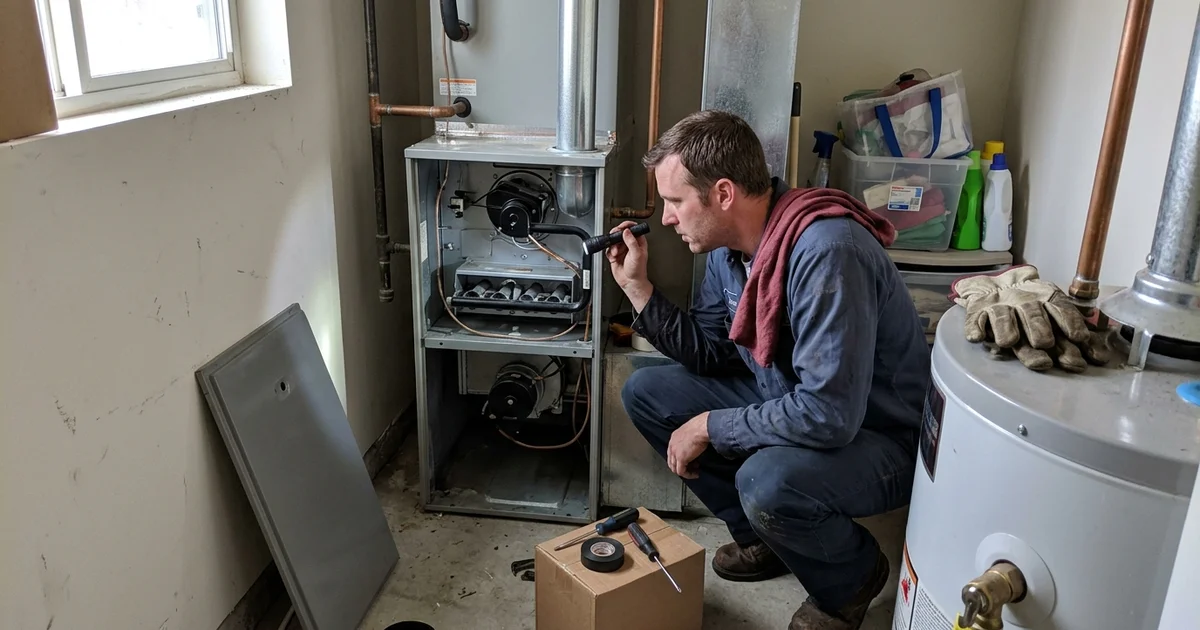
Start With the Safe Checks
Before anything else: if you smell gas, stop reading, leave the house without touching switches, and call your gas provider or 911 from outside.
Assuming no gas smell, four things are safe to check before you book furnace repair.
Thermostat. Set to heat, setpoint above room temperature, fresh batteries. A dead thermostat is indistinguishable from a dead furnace from the hallway.
Breaker. Furnaces need electricity even when they burn gas. Check the breaker and any switch near the unit, many furnaces have a service switch that looks exactly like a light switch.
Filter. A badly clogged filter causes overheating and safety lockouts. If yours is grey and matted, replace it and try again.
Furnace door. Most furnaces have a door safety switch that prevents operation with the cabinet open. If someone has been working near it, the panel may not be seated properly.
What Usually Fails
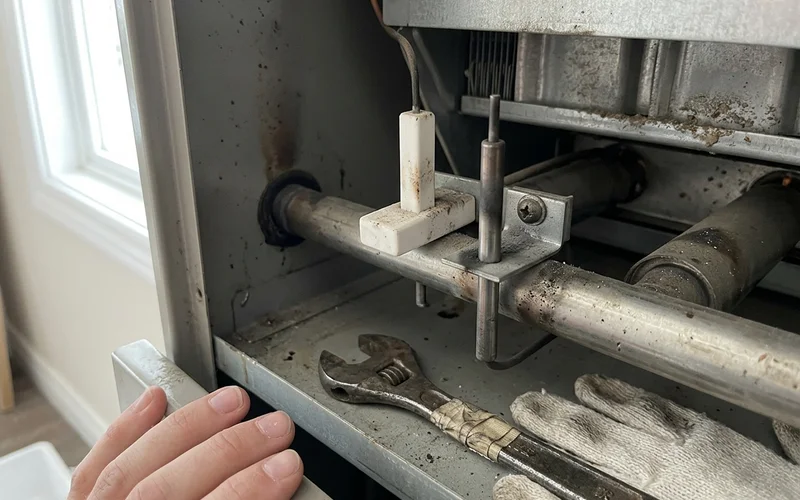
Hot surface igniter. A thin ceramic element that glows orange to light the burners. It is fragile, it degrades with every cycle, and it eventually cracks. Symptom: the furnace runs its startup sequence, you hear the inducer motor, but nothing lights.
Flame sensor. A thin metal rod in the burner flame that confirms combustion. Over time it develops an oxidized coating and stops conducting properly. Symptom: the furnace lights, runs for a few seconds, then shuts off, usually retrying two or three times before locking out. This is one of the most common furnace faults there is.
Gas valve. Either closed, or electrically failed. Symptom: full ignition sequence, no gas.
Pressure switch. Confirms the inducer motor is drawing properly before allowing ignition. A blocked flue, a cracked hose, or a failing inducer prevents it closing. Symptom: the sequence stops early, often with a specific blink code on the control board.
Standing pilot and thermocouple. On older furnaces, the pilot goes out or the thermocouple fails to hold the gas valve open.
Read the blink code
Most furnaces have an LED behind a small window on the cabinet that flashes a diagnostic pattern. Counting the flashes and checking the legend printed inside the door tells you and your technician a great deal.
Where the Line Is
Everything past the four safe checks belongs to a licensed technician, and this is one place where the line is not negotiable. You are dealing with a gas appliance, a combustion chamber, and a heat exchanger whose integrity is what keeps carbon monoxide out of your air supply.
That is also why furnace work in Alabama stays with contractors licensed by the state board and carrying insurance. The parts themselves are frequently inexpensive; what you are paying for is a correct diagnosis and a safe repair.
Why It Fails in November
Alabama furnaces sit idle from March to November. Dust settles on burners, the flame sensor oxidizes, and seals dry out. Then a cold front arrives and everyone’s furnace runs for the first time in eight months on the same night.
That is the annual pattern, and it is the practical case for a pre-winter check in October. An igniter reading out of spec in the fall is a scheduled part swap. The same igniter failing at 11 PM in January is an emergency callout, in a queue with everyone else in your county.
If your furnace lights but keeps cycling on and off rather than failing to start, that is a different fault. See the furnace short cycling guide. For a diagnosis, Furnace Repair connects you with a licensed local contractor, with a free estimate before any work.