
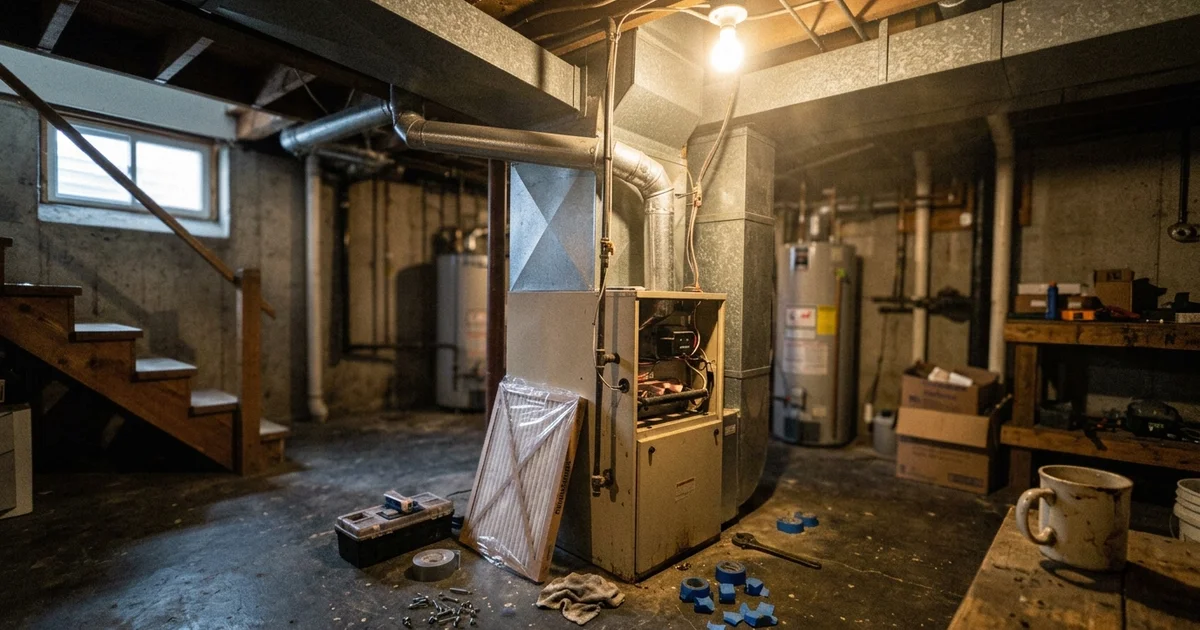
What Short Cycling Looks Like
A furnace should run in cycles long enough to bring the house up to temperature and settle, typically ten to fifteen minutes, longer on a cold morning. Anything much shorter is the pattern that sends most homeowners looking for furnace repair. Short cycling is when those runs collapse to three or four minutes, repeating over and over while the house never quite gets comfortable.
There is a specific pattern worth recognizing. The burners light, run briefly, then shut off while the blower keeps running for a while afterward. That combination, burners off, blower still going, is the signature of a high-limit switch trip, which means the furnace was overheating.
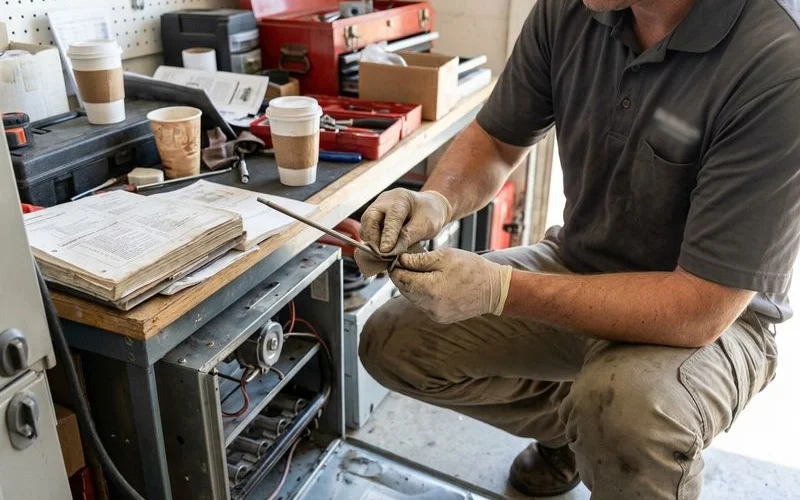
The Common Causes
Restricted airflow. The leading cause by a distance. A clogged filter, closed or blocked registers, a crushed duct run, or an undersized return means the furnace cannot move heat away from the heat exchanger fast enough. Heat builds, the limit switch trips, and the burners shut down.
Dirty flame sensor. Produces a slightly different pattern: the furnace lights and shuts off within seconds rather than minutes, usually retrying two or three times before locking out entirely. The sensor cannot confirm flame, so the control board closes the gas valve as designed.
Thermostat issues. A thermostat in direct sun, above a heat source, or with a failing temperature sensor misreads the room and cycles the furnace incorrectly. Loose wiring at the thermostat produces intermittent behavior too.
Oversized furnace. A furnace with far more capacity than the house needs satisfies the thermostat before completing a proper cycle. Common in homes where a system was replaced by matching the previous nameplate rather than running a load calculation.
Failing components. A flaky control board, a pressure switch that opens intermittently, or an inducer motor that struggles all produce cycling that comes and goes.
The five-minute check
Replace the filter, open every supply register, clear anything in front of the returns, and watch it for a day. Airflow is behind so many of these that it deserves ruling out first.
Why It Matters
Short cycling is annoying rather than alarming, which is why people tolerate it. Three reasons not to.
Every cycle starts with an ignition sequence, so a furnace cycling six times an hour is putting six times the wear on the igniter, gas valve, and control board.
Repeated overheating stresses the heat exchanger. That component is the barrier between combustion gases and the air circulating through your home, and thermal cycling is one of the things that eventually cracks it. A cracked exchanger is a replacement-level problem and a carbon monoxide risk.
And efficiency suffers. A furnace is least efficient in the first minute of a cycle, so a system that mostly runs first minutes wastes gas while heating the house unevenly.
Getting It Diagnosed
A technician will check static pressure to quantify the airflow restriction, inspect and clean the flame sensor, test the limit switch and pressure switch, examine the heat exchanger, verify the gas pressure, and check the thermostat and its wiring. If the conclusion is that the furnace is simply oversized, they will say so. That is a replacement-time fix, not a repair.
Alabama’s short heating season makes this easy to postpone. A furnace short cycling through a mild week in December still keeps the house warm enough that many homeowners wait. The cost of waiting shows up when the hard freeze arrives and the furnace locks out entirely.
If your furnace is not lighting at all rather than cycling, the furnace not igniting guide is the better starting point. For a diagnosis, Furnace Repair connects you with a licensed local contractor, with a free estimate first.