
Why a Cold Coil Turns Into an Ice Block
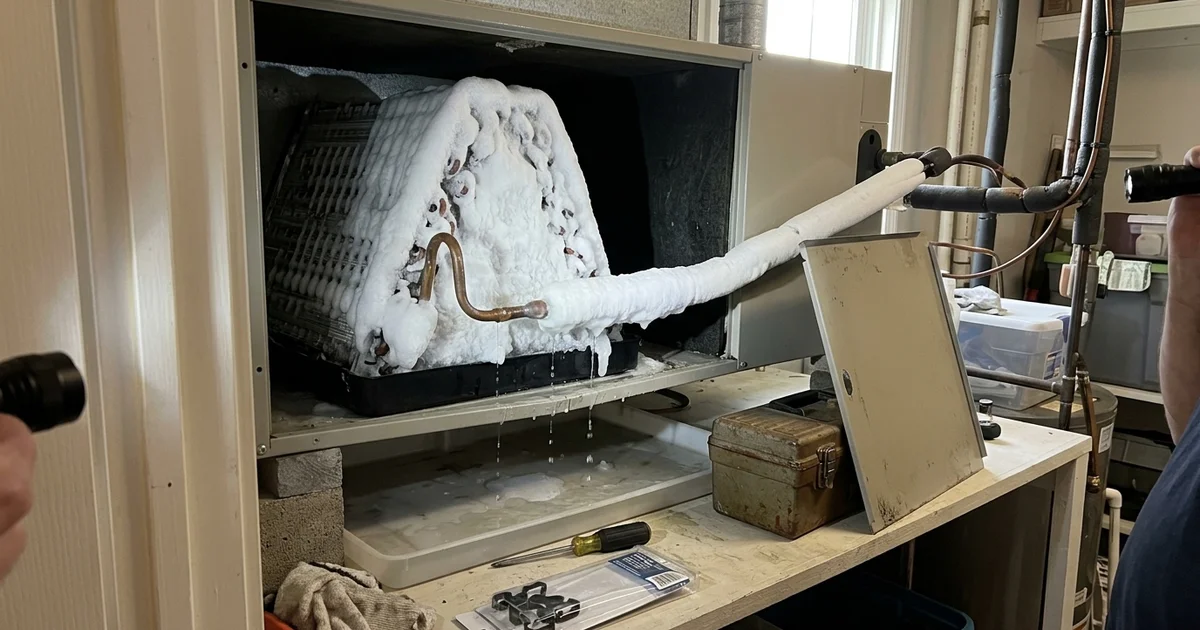
An evaporator coil gets cold, that is its job. It only turns into a block of ice when something disrupts the balance between how much heat is arriving at the coil and how much the refrigerant is absorbing.
Two conditions cause that. Restricted airflow means not enough warm air passes over the coil, so the surface temperature drops below freezing and the moisture condensing on it turns to frost instead of running off. Low refrigerant charge causes the same outcome by a different route: pressure in the coil drops, the boiling point of the refrigerant falls, and the coil runs colder than designed.
Either way the process feeds itself. Frost forms, frost blocks airflow, less airflow means colder coil, colder coil means more frost. Within a few hours you have a solid block, and the air from your vents is barely moving.
How to Thaw It Safely
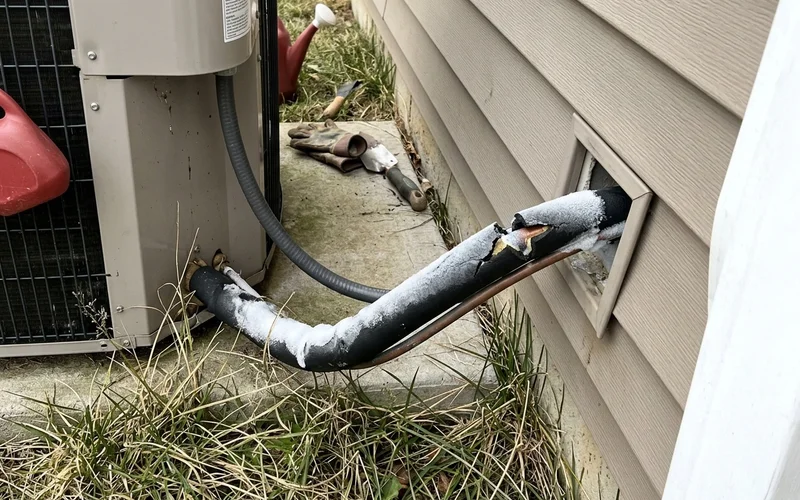
Turn the cooling off at the thermostat, then set the fan to “on” rather than auto. That circulates room-temperature air across the coil and melts the ice far faster than leaving everything off, without the risk of running the compressor against a blocked coil.
Expect one to three hours. Put towels down under the indoor unit, because all that ice becomes water and the drain pan may not keep up with it arriving at once. If your unit is in an attic, this is worth taking seriously. A large thaw can overwhelm a drain line that is already partly clogged.
While it thaws, replace the air filter. If the old one was grey and matted, you have probably found your cause. Also check that supply and return registers are open and not blocked by furniture, and take a look at the outdoor unit for grass clippings and pine straw packed against the coil.
Do not chip the ice
Evaporator coil fins and tubing are thin. A screwdriver, an ice pick, or an impatient hand can puncture the tubing, and a refrigerant leak is a much more expensive problem than a frozen coil.
Once fully thawed and dry, restart cooling and watch it. If it cools normally and does not re-freeze over the next few days, the filter was your problem. If ice comes back, stop running it and call.
The Recurrence Problem
Thawing is symptom management. This is the single most important thing to understand about a frozen coil: unless the underlying cause changed, it will freeze again, and every freeze-thaw cycle you run puts the compressor at risk.
If a new filter fixed it, excellent. If not, the likely causes are a dirty evaporator coil that a filter change cannot reach, a failing blower motor moving less air than it should, collapsed or disconnected duct reducing airflow, or a refrigerant leak. The last one is the most common in older Alabama systems, and it needs finding rather than topping up. Refrigerant is not consumed. If the charge is low, it went somewhere.
A technician diagnoses this by measuring rather than guessing: static pressure to assess airflow, temperature split across the coil, and refrigerant pressures for superheat and subcooling. Those numbers separate an airflow problem from a charge problem in one visit. AC Repair connects you with a licensed contractor who does exactly that, with a free estimate before any work.
Alabama-Specific Factors
Long runtime is the background condition. A system running most of the day for five months has far more opportunity to freeze than one running intermittently, and small problems compound faster.
Humidity matters too. There is simply more moisture in Alabama air, which means more condensate available to become frost when the coil runs cold. And pollen season loads filters faster than most homeowners expect, so a filter that would last three months in a cleaner climate clogs in six weeks here in the spring.
Coastal homes carry a fourth factor: salt-air corrosion produces pinhole refrigerant leaks in condenser coils earlier than inland systems experience them, and low charge is a leading cause of freezing.
If the system is running but the air is warm rather than the coil being visibly iced, the AC not cooling guide is the better starting point. For the prevention side of this, what maintenance actually stops coils freezing in the first place, the why AC coils freeze guide covers the tune-up angle.